Showing posts with label Animal. Show all posts

Sunday, May 11, 2025

Stone Lion of Independence Square, Colombo – Symbol of Sri Lanka’s Freedom and Strength

Stone Lion of Independence Square, Colombo – Symbol of Sri Lanka’s Freedom and Strength

 Stone Lion of Independence Square, Colombo – Symbol of Sri Lanka’s Freedom and Strength

The Lion of Colombo: Stone Strength in Sri Lanka’s Heart of Freedom

A silent sentinel sits at the top of a wide flight of stone steps in the heart of Independence Square, Colombo. Hewn from solid stone, this lion statue is more than an ornamental piece—it is a visual symbol of Sri Lanka’s strength, cultural pride, and hard-won independence.

The photo above captures this stone lion in stunning clarity, its rough texture, proud expression, and dignified posture giving the image both artistic appeal and historic weight. With its symmetrical stance, weather-worn yet noble face, and powerful front paws resting firm on the stone, this sculpture seems to watch over the square—not as a relic, but as a guardian of freedom.

Let’s explore this image and its context in more detail, from both an artistic and historic lens.


The Stone Lion: A Symbol Etched in Strength

The lion has long been an enduring symbol of power, protection, and sovereignty in Sri Lankan culture. It features prominently on the country’s national flag and is deeply connected with the island’s Sinhalese heritage. This particular lion statue, part of a series found at Independence Memorial Hall, stands not just as an artistic object but as a metaphor for the strength of the Sri Lankan people.

In this image, the lion’s features are strong but weathered, soft around the edges yet unmistakably proud. Its mane is carefully sculpted, stylized into ridges that echo traditional Sinhalese art. The symmetry of its form and the directness of its gaze create a sense of watchfulness and protection.

There is no elaborate pedestal, no decorative flare—it is this stoic simplicity that draws attention. This lion doesn’t roar—it endures. And in doing so, it becomes a silent emblem of resilience.


Abstract Interpretations for Artistic Viewers

For lovers of abstract imagery, this statue speaks in metaphor. One could interpret it as:

  • A representation of inner strength, standing firm amid life’s uncertainties.

  • A commentary on stillness amid motion, as modern life rushes around the statue that has stood for decades.

  • A study in contrast, with rough, timeless stone against the transience of people who come and go.

Its placement on the steps also implies ascendancy. The lion is not merely guarding the entrance; it is part of the path upward, suggesting that strength and freedom are milestones along a journey—not destinations in themselves.

Photographs like this one appeal to those who love symbolic decor, minimalistic textures, and culturally rich visual narratives.


Independence Square, Colombo: A Landmark of Liberation

The lion statue finds its home at one of Sri Lanka’s most historically significant locations—the Independence Memorial Hall, located at Independence Square in Colombo.

This hall was built to commemorate the island’s freedom from British colonial rule, which was officially achieved on February 4, 1948. The structure is both ceremonial and symbolic. Its architecture draws inspiration from ancient Sinhalese royal assembly halls, particularly the one at Kandy, the last stronghold of the Sinhalese kings before colonial rule took hold.

Independence Memorial Hall is not just a monument—it is a living, breathing public space. Locals gather here for celebrations, morning walks, peaceful reflection, and even protests when needed. At its heart, it houses a statue of D. S. Senanayake, Sri Lanka’s first Prime Minister—another enduring symbol of the country's hard-earned freedom.

Surrounding the hall are beautifully landscaped gardens and long stone paths where you can often see children playing, joggers running, or tourists absorbing the moment. The lion statues add to the aura, framing the space as one of dignity, pride, and reflection.


Sri Lanka’s Journey to Independence: The Context

To fully appreciate the symbolism of the lion, one must understand the broader story of Sri Lanka’s independence.

Colonized first by the Portuguese, then the Dutch, and finally the British, Sri Lanka (formerly Ceylon) was under European rule for over four centuries. The 19th and 20th centuries saw a rising national consciousness, powered by cultural revival, education, and political activism. The lion flag—symbol of the Sinhalese kings—was revived as a national emblem, reminding people of their indigenous identity and pride.

Leaders like Anagarika Dharmapala, Ponnambalam Ramanathan, and later D. S. Senanayake worked tirelessly to build the foundations of a free state. The independence movement was relatively non-violent but firm, asserting Sri Lanka's right to self-governance and cultural preservation.

It was a peaceful transition—a rare and dignified handover of power, which is why the memorial is less militaristic and more ceremonial. The lion here is not a beast of war but a keeper of peace, watching over a nation that emerged through dialogue and resilience, not bloodshed.


Why This Image Stands Out

This particular photograph is both personal and universal. Whether you’re a student of architecture, a traveler who appreciates cultural sites, or an art enthusiast with a taste for symbolic imagery, this image has layers to explore.

The gray tones make it visually calming—an ideal aesthetic for gallery prints, home decor, or minimalist merchandise. The sculpture’s emotional neutrality invites the viewer to project their own interpretation onto it. Some may see it as stoic and protective, others as lonely or introspective.

It works just as well as a symbol of cultural pride as it does an abstract representation of inner fortitude.


Artistic and Commercial Applications

This stone lion image is ideal for:

  • Poster art in meditation or yoga studios (evoking strength and grounding).

  • T-shirt designs that carry cultural depth.

  • Home decor prints for modern, minimalist homes.

  • Book covers on topics of freedom, resilience, or South Asian culture.

  • Travel blogs and editorial features focusing on Colombo or South Asian history.

  • Greeting cards for occasions celebrating courage or milestones.

Because of its neutral palette and universal form, the image can also be easily adapted into black-and-white artworks, embossed wall art, or sketch-style renderings.


Interested in Using This Image?

If this image resonates with you and you’d like to use it for editorial, stock, or merchandise purposes, feel free to leave a comment below. I will personally reach out to:

  • Provide high-resolution versions suitable for print

  • Offer custom crops or edits for product designs

  • Share licensing terms for commercial use

  • Collaborate on specific merchandise (t-shirts, mugs, calendars, etc.)

I’m open to both one-time licenses and ongoing creative partnerships—especially if you’re working on projects that celebrate heritage, resilience, and visual storytelling.


Final Thoughts: More Than a Sculpture

This lion, like the people of Sri Lanka, stands tall despite time’s wear and tear. It is made of stone, but it speaks. It guards a space of memory and motion. And it reminds us that freedom is not just a date in history—it is a feeling we preserve, protect, and pass on.

It’s a quiet reminder that strength can be gentle, that history can be beautiful, and that monuments are not just made of granite, but of purpose and pride.

Want to improve your photos? Buy Photoshop and see how your images come to life. Click to buy.

Want to get tips for improving your photography ? Get Photo Tips from this blog.

Sunday, May 04, 2025

Goats, Waves, and Quiet Days: A Moment at the Edge of the Shore

Goats, Waves, and Quiet Days: A Moment at the Edge of the Shore

 Goats, Waves, and Quiet Days: A Moment at the Edge of the Shore

In this image, the sea is gentle, the waves lapping against the concrete slope of a modest beach.
A man in a light blue shirt sits near the water’s edge—perhaps resting, perhaps reflecting, perhaps simply watching the waves roll in.

And then, in this slow moment, something curious passes through the frame: goats.
Not one, but at least two goats, moving casually past the man, unfazed by the water, by the presence of people, or even by the camera.

It is a moment full of contrast, and yet it feels completely natural.
The beach isn’t grand. The sea isn’t wild. The goats aren’t exotic.
But the scene is poetic in its ordinariness.


The Mood of the Image: Quiet, Curious, Connected

What strikes you first is the stillness.
The kind of stillness you only find near water—where time softens, sounds stretch, and thoughts slow down.

  • The man doesn’t seem in a rush.

  • The goats move with the casual rhythm of village life.

  • The sea performs its slow, continuous music in the background.

It’s a scene of quiet coexistence—between man and nature, between land and sea, between movement and rest.


An Abstract Frame: Motion and Stillness Together

For those who appreciate abstract imagery, this photo reads like a visual poem:

  • The goat in mid-step, caught in motion, its muscles gently tense.

  • The man seated, shoulders rounded, focused inward or downward.

  • The waves, not crashing but rolling, a dance of repetition.

There is no centerpiece. No staged subject.
And yet, the composition speaks volumes.

It’s the kind of image that invites you to pause, just like its subjects.


Nature’s Unpredictable Cast: Goats by the Sea

Goats aren’t usually what you expect at a beach.
And that’s what makes their presence so charming.

  • Their slender frames and curved horns bring a rugged elegance.

  • Their slow walk across the frame adds humor and warmth.

  • Their complete comfort in this setting reminds us how adaptable life is.

In rural or semi-urban coastal India, such moments aren’t rare.
Animals roam freely. People live close to the shore. Boundaries blur between the wild, the tame, the personal, and the shared.

This is a snapshot of that world—a place where goats and waves pass by with equal ease.


The Unseen Story: What Might Be Happening Here

There’s a story behind every still image—even when you don’t know the details.

  • The man might be a local fisherman taking a break.

  • He could be folding nets, rinsing tools, or simply sitting in meditation.

  • The goats may belong to him. Or perhaps they’re just strays following their own curiosity.

And that’s the beauty of this image: it doesn’t tell you everything.
It invites you to imagine, to wonder, to create your own version of what came before and what might come after.


The Slowness of Life by the Water

There’s something timeless about beaches that don’t cater to tourists.
They aren’t lined with shacks or umbrellas. There’s no music playing.
Just the natural rhythm of the place—people, animals, elements.

This photo captures that slowness beautifully:

  • The patience of water, moving constantly yet never rushing.

  • The calm of the man, immersed in his own small world.

  • The casual curiosity of goats, wandering without urgency.

It is a world that resists clocks.
That says: “This moment is enough.”


Texture, Color, and the Composition of Simplicity

There is a quiet balance in the composition:

  • Color: The soft blue of the shirt, the creamy white of the goats, the earthy tones of the shore, the deep green of the sea.

  • Texture: Rough concrete underfoot, coarse fur on the goats, foamy crests on the water.

  • Lines: The horizon formed by waves, the sloping platform, the angles of legs and horns.

Nothing is polished. Nothing is posed.
But everything feels intentionally placed, as if nature arranged it all just for this frame.


A Reminder: Beauty Isn’t Always Loud

In a world flooded with filters and perfection, this image reminds us that beauty can be:

  • As simple as a goat walking by.

  • As natural as a man sitting on a ledge.

  • As eternal as the sea meeting the land.

There is no grandeur here.
Just a quiet honesty—the kind that resonates long after you've looked away.


Closing Reflection: The Poetry of Ordinary Things

This is more than a picture of goats and waves.
It’s a meditation on stillness, simplicity, and unexpected joy.

It tells us:

  • That life doesn’t have to be extraordinary to be meaningful.

  • That nature often provides the most interesting characters.

  • That pauses matter more than we realize.

So next time you find yourself by the water—or watching animals pass—or simply sitting quietly—remember this image.

Because sometimes, the most meaningful moments are the ones no one else notices.


🖼️ Interested in Using This Image?

If you would like to use this image for stock purposes, or as a poster, greeting card, t-shirt, or framed print, you're welcome to reach out.

Please leave a comment below with your request, and I will get back to you personally with licensing or customization options.

Whether you're a designer, collector, or just someone who connects with the mood of this photograph, I’m happy to help bring this visual story into your space.

Want to improve your photos? Buy Photoshop and see how your images come to life. Click to buy.

Want to get tips for improving your photography ? Get Photo Tips from this blog.

Saturday, May 03, 2025

Spotted Grace: The Timeless Beauty of the Indian Chital (Spotted Deer)

Spotted Grace: The Timeless Beauty of the Indian Chital (Spotted Deer)

 Spotted Grace: The Timeless Beauty of the Indian Chital (Spotted Deer)

In the image above, a spotted deer, or chital, stands in silent alertness on the forest floor.
Its body is marked with elegant white spots against a reddish-brown coat. Its antlers curve upward with gentle strength. Around it lies dry earth and scattered greenery—its natural habitat, unbothered and wild.

This isn't just a photograph.
It's a moment.
A quiet frame in the never-ending rhythm of the jungle—where survival meets grace and the ordinary becomes extraordinary.


A Closer Look at the Chital: Nature's Masterpiece

The spotted deer (Axis axis) is one of the most recognized and beloved animals in Indian forests.

  • Coloration: Reddish-brown with distinctive white spots running along its flanks and back. These spots remain through life, unlike some deer species that only have them as fawns.

  • Antlers: Only the males grow antlers, which usually have three tines and can grow impressively long.

  • Size: Adult males can weigh between 70 to 85 kg and stand about 90 cm at the shoulder. Females are smaller, more slender.

  • Eyes and Ears: Large, expressive eyes and constantly twitching ears help the chital stay alert in its predator-rich ecosystem.

Its appearance combines the elegance of form with the efficiency of evolution—a creature built for both beauty and survival.


The Social Life of the Spotted Deer

Chitals are highly social animals. They live in herds that often consist of 10–30 individuals but can sometimes number in the hundreds, especially in regions with abundant water and food.

  • Group Structure: A herd usually includes females, fawns, and a few males. Older males may roam alone or form bachelor groups.

  • Vocalization: They are known to produce sharp barks, especially when alarmed—often warning other animals of predators like tigers or leopards.

  • Mutualism: Interestingly, chitals are often seen alongside langurs (monkeys). The monkeys drop fruit from trees, and in return, the deer alert them of ground threats.

This behavior shows that cooperation across species isn’t just human—it thrives in the wild too.


Habitat and Distribution

The spotted deer is native to the Indian subcontinent. It is widely distributed across:

  • India (from the Himalayan foothills to the southern forests)

  • Sri Lanka, Nepal, and Bangladesh

Chitals prefer dry deciduous forests, grasslands, and open plains near water bodies. They are grazers and browsers—eating grass, leaves, and fruits.

National parks where you're most likely to see them include:

  • Kanha National Park

  • Bandipur Tiger Reserve

  • Ranthambore National Park

  • Jim Corbett National Park

  • Bandhavgarh and Pench Tiger Reserves

They are also found in protected city forests, often calmly crossing park roads or grazing near forest rest houses.


Fawns and Family

The birth of a chital fawn is a quiet miracle in the wild.

  • Breeding occurs year-round, though there’s a peak during monsoons.

  • After a gestation of about 7–8 months, a female gives birth to a single fawn.

  • The fawn is born with spots and begins walking within minutes.

  • For the first few weeks, it stays hidden in tall grass while the mother grazes nearby.

These early days are critical—danger lurks at every corner from leopards, wild dogs, and snakes.

Despite this, chital populations have remained relatively healthy thanks to their adaptability, speed, and group dynamics.


The Spotted Deer in Popular Culture

The beauty of the chital hasn’t gone unnoticed by filmmakers, photographers, and writers.

In Cinema & Documentaries:

  • Spotted deer frequently appear in BBC nature documentaries, often in scenes involving tiger stalking sequences in Indian jungles.

  • In The Jungle Book (Disney and Rudyard Kipling), while the deer is not named, its presence sets the stage for the predator-prey dynamics of the forest.

  • Indian wildlife documentaries, including those by Valmik Thapar and Bittu Sahgal, often showcase chital herds to illustrate healthy jungle ecosystems.

Symbolism and Storytelling:

In Indian mythology, deer often symbolize gentleness and grace.
In some Buddhist and Jain traditions, the deer represents peace, kindness, and the absence of ego.

It is an animal that, despite its vulnerability, walks the earth with quiet dignity.


Why We Love the Chital: An Abstract Appreciation

For viewers who enjoy abstract images and symbolism, this deer stands for more than its physical form.

  • The spots echo constellations—tiny stars sprinkled across the canvas of its coat.

  • The antlers, symmetrical yet unique, suggest growth, branching out, and nature’s geometric artistry.

  • The stance—alert yet calm—embodies mindfulness, being fully present in the moment.

In abstract art and thought, the chital reminds us of the balance between awareness and grace.

It shows that beauty doesn’t always need to be loud or aggressive—it can stand quietly and still capture every eye.

Want to improve your photos? Buy Photoshop and see how your images come to life. Click to buy.

Want to get tips for improving your photography ? Get Photo Tips from this blog.

Monday, August 05, 2019

Swimming turtle inside the Singapore Botanic Garden

A turtle in a small water body inside the Singapore Botanic Garden. The turtle was an instant magnet for children, with the enclosure fence surrounded by children (some on the shoulders of their parents, when they were to small to see over the fence). People had to drag their children away after 5 minutes or so, so that they go and see the other parts of the Botanic Garden, and there are a lot of items to see in the Garden (Orchid Garden, Cool House, Rain Forest, and many other such attractions, all waiting for people to come and see).

Swimming turtle inside the Singapore Botanic Garden (More Photos / Prints)

The Singapore Botanic Garden is one of the famous landmarks and tourist attractions of Singapore, and is also a great attempt to showcase nature and diversity. The garden is a large place, covering a space of 82 hectares. The garden was originally setup in 1822, was closed in 1829, and then re-opened in 1859. Entry to the garden is free for visitors, although entry to the National Orchid Garden inside the Botanic Garden does cost Singapore $5 for entry. Inside the Botanic Garden, you can also see a number of families who come there to relax and sit down, a sort of picnic. The garden is also a UNESCO World Heritage site. The garden has around 10,000 species of flora within its precints.

Want to improve your photos? Buy Photoshop and see how your images come to life. Click to buy.

Want to get tips for improving your photography ? Get Photo Tips from this blog.

Tuesday, November 20, 2018

Baby orangutan in the Singapore Zoo - Facebook post

Baby orangutan in the Singapore Zoo - Facebook post
Baby orangutan in the Singapore Zoo - Facebook post 
Baby orangutans in the Singapore Zoo, trawling on the side of the net. These orangutans have their exhibit near the starting point of the circular trail of the zoo, and with a net hanging on the tree. These orangutans are one of the major attractions of the zoo, especially when visitors come inside the zoo, get near the starting point of the battery cars inside the zoo. The orangutans also form part of an attraction inside the Singapore Zoo called 'Breakfast with the Orangutans'. This show can be busy sometimes, so if you want you or your kids to enjoy the show, you might want to check out the booking much in advance (we tried to book 2 weeks in advance, but was unavailable on the day we wanted).
https://www.facebook.com/SingaporeTourist/photos/a.1825035014185805/2058702864152351/?type=3&theater

If you are planning to visit Singapore, then a travel guide would be helpful. https://amzn.to/2yu1cGw

The Singapore Zoo has a number of different events and shows, you should go through the site of the zoo to find out more. https://www.wrs.com.sg/en/singapore-zoo.html

Want to improve your photos? Buy Photoshop and see how your images come to life. Click to buy.

Want to get tips for improving your photography ? Get Photo Tips from this blog.

Monday, November 05, 2018

Singapore Zoo - Buff cheeked Gibbon

Singapore Zoo - Buff cheeked Gibbon
Singapore Zoo - Buff cheeked Gibbon 
Buff cheeked gibbon at the Singapore zoo in its exhibit at the Singapore Zoo. The gibbon is now considered endangered with a loss in numbers of more than 50% over the past 45 years, and is found in the wild in South East Asia (Cambodia, Vietnam, and Laos). 
These animals feed mainly on leaves and fruit, with an averge group size of 3-5 individuals. 
This Gibbon is also known as the yellow-cheekedGibbon, Golden Cheeked Gibbon, and a couple of other even longer names.

If you are planning to visit Singapore, then a travel guide would be helpful. https://amzn.to/2yu1cGw

The Singapore Zoo has a number of different events and shows, you should go through the site of the zoo to find out more. https://www.wrs.com.sg/en/singapore-zoo.html

Want to improve your photos? Buy Photoshop and see how your images come to life. Click to buy.

Want to get tips for improving your photography ? Get Photo Tips from this blog.

Wednesday, February 20, 2013

Head of the Bottle Nose dolphin moving out of the water near Sharm el Sheikh

Body of dolphin emerging from below the water of the Red Sea near Sharm el Sheikh


Body of dolphin emerging from below the water of the Red Sea near Sharm el Sheikh. For around 10-15 minutes, we just watched these Bottle Nose dolphins moving in and out of the water surface.

Head of the Bottle Nose dolphin causing a wave in the water of the Red Sea in Egypt


Head of the Bottle Nose dolphin causing a wave in the water of the Red Sea in Egypt

The Red Sea is a narrow stretch of sea, primarily between the countries of Egypt and Saudi Arabia. This sea has a number of coral reefs along with the associated marina life. The area near the tourist town of Sharm el Sheikh boasts a protected water sanctuary called the Ram Mohammed Park; and a large number of tourists come to this area to see the coral reefs - both at the surface in the form of snorkeling, and under the surface through the form of scuba diving. We were on our way to this area on a boat, when we saw that a number of ships in front of us were all circling around and soon the staff of our ship told us that they were all circling a small group of dolphins. Now the prospect of seeing dolphins in the wild was something very exciting, and so we also soon reached the area. This was the first time I had seen dolphins outside of a movie, and it was an incredible site, watching these intelligent mammals on the surface and below the surface. Dolphins are estimated to be the most intelligent out of the various species in the water, and humans have a fascination for these animals.
Sharm El Sheikh (New Millennium Collection: North Africa)
View Larger Map

Want to improve your photos? Buy Photoshop and see how your images come to life. Click to buy.

Want to get tips for improving your photography ? Get Photo Tips from this blog.

Tuesday, February 19, 2013

The sight of dolphins at the water surface at the Red Sea near Sharm el Sheikh

Head of the Bottle Nose dolphin emerging from the water of the Red Sea near Sharm el Sheikh


The head of the Bottle Nose dolphin emerging from the water of the Red Sea near Sharm el Sheikh. It was great fun watching these mammalian creatures moving fluidly in and out of the water.

Dolphin emerging in and out of the water of the Red Sea near Sharm el Sheikh in Egypt


Dolphin emerging in and out of the water of the Red Sea near Sharm el Sheikh in Egypt

Dolphins are supposed to be one of the more intelligent species of animals in the world, counted among the whales, elephants and other animals that are supposed to have a high degree of intelligence (next only to humans and some of the ape species). Dolphins are also killed world wide, many times caught in the major industrial fishing operations, and also hunted down as well. Other species such as river dolphins face problems due to the increasing amount of pollution in rivers and also the various restrictions on the free flow of water in these rivers (dams, and other such restrictions). We got a sight of some Bottle Nose dolphins near the Ras Muhammed marine park near the tourist town of Sharm el Sheikh. We were on our way to the coral formations for some snorkeling, and on the way, came across these dolphins on the water surface. For around 10-15 minutes, we had a sight of 3-4 dolphins on the water surface, and sometimes under the water surface. Finally, they left and then we moved on from that area.
Sharm El Sheikh (New Millennium Collection: North Africa)
View Larger Map

Want to improve your photos? Buy Photoshop and see how your images come to life. Click to buy.

Want to get tips for improving your photography ? Get Photo Tips from this blog.

Monday, February 18, 2013

Presence of dolphins under surface of Red Sea near Sharm el Sheikh

The shape of the dolphin can be clearly made out below the water surface of the Red Sea


The shape of the dolphin can be clearly made out below the water surface of the Red Sea

The dorsal fin of the dolphin visible on the surface of the Red Sea near Sharm el Sheikh


The dorsal fin of the dolphin visible on the surface of the Red Sea near Sharm el Sheikh

Why do people get excited over some sights ? Well, when you watch something magnificent, the sight looks incredible. One such sight is the view of animals in the wild such as whales, dolphins, and sharks. People think about sharks with fear and about whales and dolphins with great enjoyment, even paying sums of money for trips where you could get to see dolphins and whales in their own surroundings. We got to see some dolphins near the tourist town of Sharm el Sheikh, on the way to the Ram Muhammed water park. In this park, there are a large number of coral formations, along with the beautiful marine life that accompany such coral formations. On the way, we noticed other tourist ships stopped and circling and could see that they were circling a group of dolphins in the water. As we got closer, we could see that there were around 3-4 dolphins present, and they were there for around 10-15 minutes before sliding under the surface of the water and vanishing.
Sharm El Sheikh (New Millennium Collection: North Africa)
View Larger Map

Want to improve your photos? Buy Photoshop and see how your images come to life. Click to buy.

Want to get tips for improving your photography ? Get Photo Tips from this blog.

Sunday, February 17, 2013

Appearance of Bottle Nose dolphins under the water surface of the Red Sea

Shadow of Dolphin under the water of the Red Sea near Sharm el Sheikh in Egypt


Shadow of Dolphin under the water of the Red Sea near Sharm el Sheikh in Egypt

Shadow of 2 Bottle Nose dolphins under the water of the Red Sea near Sharm el Sheikh


Shadow of 2 Bottle Nose dolphins under the water of the Red Sea near Sharm el Sheikh

It is a treat of nature to watch wild animals (especially large animals). So people go long distances to watch whales in their environment, people spend large amounts of money to go to the vast animals herds in Africa and to watch great predators in action. And them sometimes one comes across some wonderful animals in the wild, almost by change. We were in Sharm el Sheikh as part of the final leg of the tourist trip to Egypt (after having visited a number of ancient temples, the pyramids, the Sphinx and also having done a cruise on the river Nile). In Sharm el Sheikh, we were on our way to the Ras Muhammed marine park, a protected sanctuary which houses some amazing coral formations. The plan was to do snorkeling at 3 different locations, and we were promised some wonderful coral and the marine animals that lived there. However, there was no mention of dolphins, and so it was a huge treat when the ship slowed down on the way to the coral formations, and we could see dolphins in the water (there were around 3-4 dolphins that were visible), making their way on and under the water surface, such as can be seen in these shadows of the dolphins under the water. It was a magnificent view.
Sharm El Sheikh (New Millennium Collection: North Africa)
View Larger Map

Want to improve your photos? Buy Photoshop and see how your images come to life. Click to buy.

Want to get tips for improving your photography ? Get Photo Tips from this blog.

Saturday, February 16, 2013

Dolphins diving under the water of the Red Sea near Sharm el Sheikh

Bottle Nosed dolphin diving under the water of the Red Sea near Sharm el Sheikh


Bottle Nosed dolphin diving under the water of the Red Sea near Sharm el Sheikh

Spectral shadow of the diving dolphin as it dives under the water of the Red Sea

Spectral shadow of the diving dolphin as it dives under the water of the Red Sea

This was one of the plus points of our trip to Egypt. Now most people who go to Egypt go there to admire the ancient heritage, the various monuments that attest to the history of pharaohs in Egypt (and some of those monuments are incredible, leave you with a feeling of awe and grandeur). But Egypt also has another location which draws a large number of tourists - this is the city of Sharm el Sheikh. Sharm el Sheikh is located near the southern tip of the Sinai peninsula in Egypt, and sees a large number of tourists. Sharm el Sheikh has excellent weather, especially in the winter months which are very cold in Europe and Russia (which draws tourists from those regions to Sharm el Sheikh). In addition, the water of the Red Sea, the beaches, all these factors make it more attractive. And then there are the coral formations, and the marine animals. However, on the way to these coral formations, we came across these dolphins in the Red Sea, and we were near them for 10-15 minutes before they finally dove under the water.
Sharm El Sheikh (New Millennium Collection: North Africa)
View Larger Map

Want to improve your photos? Buy Photoshop and see how your images come to life. Click to buy.

Want to get tips for improving your photography ? Get Photo Tips from this blog.

Dorsal fin of bottle nosed dolphins on the water surface

Dorsal fin of the Dolphin as it dives below the surface of the water near Sharm el Sheikh in the Red Sea

Dorsal fin of the Dolphin as it dives below the surface of the water near Sharm el Sheikh in the Red Sea

Splashing of water around the dorsal fin of the dolphin in the Red Sea near Sharm el Sheikh


Splashing of water around the dorsal fin of the dolphin in the Red Sea near Sharm el Sheikh

Most people do not get a sight of dolphins in the wild, in their natural environment even if it is from the distance of a ship. We had this luck. After this experience, I realized why people have the wish to see animals in the vast wilderness of Africa, or pay a lot of money to see whales through whale tours. It was an incredible experience. We had headed out from Sharm el Sheikh harbor in a small ship along with some other tourists towards the Ram Muhammed water sanctuary around 12km away, and were close to the destination when we saw the ship slowing down and other ships slowly circling ahead. Our guide grew very excited and told us that there were dolphins in the area, and we all crowded the front area of the ship to see these dolphins. There were not many that were to be seen, around 3-4, and they were there in the area for around 15 minutes, swimming below and on the water surface and coming up to breathe. It was great fun.
Sharm El Sheikh (New Millennium Collection: North Africa)
View Larger Map

Want to improve your photos? Buy Photoshop and see how your images come to life. Click to buy.

Want to get tips for improving your photography ? Get Photo Tips from this blog.

Tuesday, February 05, 2013

Dolphins on the surface of the water near Sharm el Sheikh in the Red Sea

Couple of bottle nosed dolphins on the water surface at Sharm el Sheikh in the Red Sea

Couple of bottle nosed dolphins on the water surface at Sharm el Sheikh in the Red Sea

Dolphin emerging from the waters of the Red Sea off the coast of Sharm el Sheikh in Egypt

Dolphin emerging from the waters of the Red Sea off the coast of Sharm el Sheikh in Egypt

We had gone on a trip to the tourist town of Sharm el Sheikh. This is a town located on the Red Sea, near the southern tip of the Sinai Peninsula in Egypt. It is very different from the rest of the tourist destinations in Egypt, which focus on the monuments from ancient Egypt (from the time of the pharaohs). However, Sharm el Sheikh is an entirely different location, more famous for the water, the excellent temperate weather, and the long beaches. People come here to relax on the beaches (and many of the large resorts located here have some great beaches of their own), especially in the winter months when many parts of the Northern Hemisphere are drowning in snow and ice (and many countries in Europe have temperatures below to or close to the freezing point). Another great attraction of Sharm el Sheikh are the protected water sanctuaries that protect coral formations (and the large amounts of marine animals in these coral reefs). People come here to do scuba diving or snorkeling, and once in a while you can get to see a sight of dolphins that also live in the Red Sea. These were a set of such dolphins that we were able to see while on the way to the coral formations, and it was incredible seeing them, since I had never seen a dolphin except on TV.
Sharm El Sheikh (New Millennium Collection: North Africa)
View Larger Map

Want to improve your photos? Buy Photoshop and see how your images come to life. Click to buy.

Want to get tips for improving your photography ? Get Photo Tips from this blog.

Monday, February 04, 2013

Dolphins under the water surface, off the coast of Sharm El Sheikh

Dolphins just under the water surface in the Red Sea off the coast of Sharm el Sheikh in Egypt

Dolphins just under the water surface in the Red Sea off the coast of Sharm el Sheikh in Egypt

Bottle nosed dolphin, just under the water surface in the Red Sea off the coast of Sharm el Sheikh in Egypt

Bottle nosed dolphin, just under the water surface in the Red Sea off the coast of Sharm el Sheikh in Egypt

The waters off the coast of the city of Sharm el Sheikh are a very rich place; being a protected place in the Red Sea. A large number of tourists come to Sharm el Sheikh all around the year, with some excellent weather (especially in winter when North Europe and North America is freezing under the bitter cold) with the weather being temperate all year round. In addition, the blue water, the coral formations in multiple locations, and the scuba diving and snorkeling available with such coral reefs draws a huge number of people the year round. The Red Sea also contains dolphins, and with many chunks of the marine area having been declared as protected area, these animals do not face any threat from fishing, and the coral formations are also protected. Tourists take boats or small ships to these coral formations, such as we did. On the way to these coral formations, we came across a pod of dolphins, and had some great fun watching them (especially since for city slickers such as us, the chance of watching dolphins in the wild would never happen). In these photos, the dolphins were under the water surface, but clearly visible.
Sharm El Sheikh (New Millennium Collection: North Africa)
View Larger Map

Want to improve your photos? Buy Photoshop and see how your images come to life. Click to buy.

Want to get tips for improving your photography ? Get Photo Tips from this blog.

Wednesday, December 12, 2012

Head and upper body of a Bottle Nose Dolphin emering from the water in the Red Sea near Sharm el Sheikh

Head and upper body of a Bottle Nose Dolphin emering from the water in the Red Sea near Sharm el Sheikh

The Red Sea is one of the smaller seas of the world, connecting the Indian Ocean and the Mediterranean Sea (almost touching the Mediterranean, this connection was made with the construction of the Suez Canal), but has some exceedingly beautiful coral formations in the shallower parts of the Red sea. Portions of these shallower coral formations are found in the Ras Mohammed marine park (a protected stretch of water containing a number of beautiful coral formations). We were on our way to the coral formations from the Sharm el Sheikh coastline in a tour ship run by one of the operators over there, and on the way we came across a pod of Bottle Nose dolphins; coming across this pod was a treat and we spent some time around the location of these dolphins (along with many other ships that also landed up in the area) until the dolphins made their move and got out of the area.
Sharm El Sheikh (New Millennium Collection: North Africa)
View Larger Map

Want to improve your photos? Buy Photoshop and see how your images come to life. Click to buy.

Want to get tips for improving your photography ? Get Photo Tips from this blog.
Tuesday, December 11, 2012

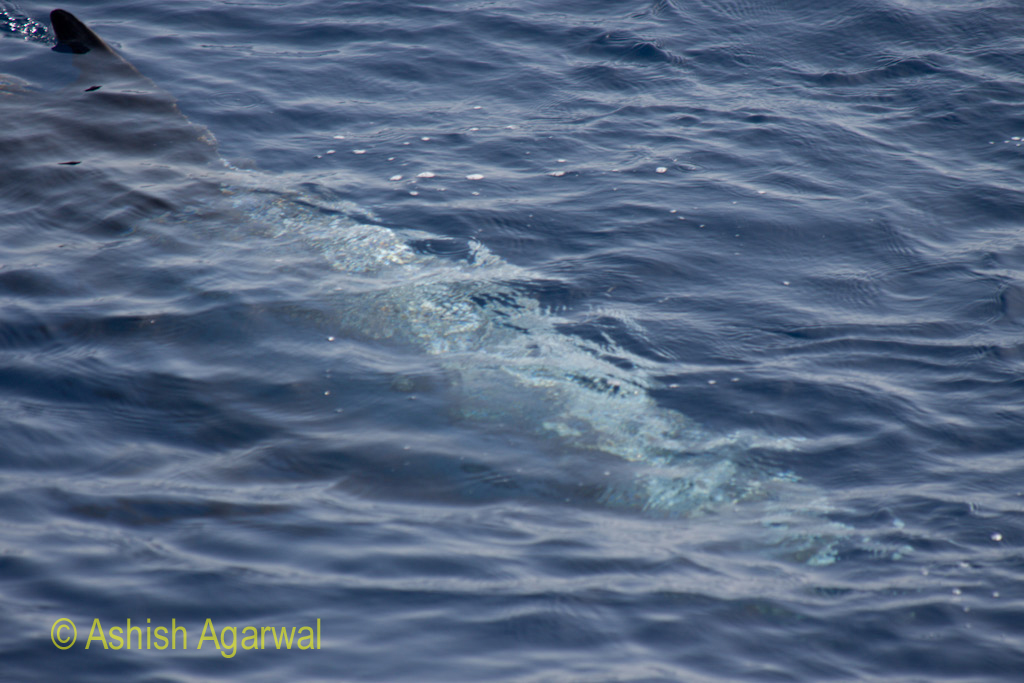
A submerging bottle nose dolphin in the Red Sea off the coast of Sharm el Sheikh in Egypt

A submerging bottle nose dolphin in the Red Sea off the coast of Sharm el Sheikh in Egypt

A Bottle nose dolphin, with the body of the dolphin almost fully submerged. The only part of the dolphin visible above water was the fin of the dolphin, which had not yet gone below water. This was one of the dolphins that were part of a small pod of dolphins (not sure about the size of the pod since we could see only 3 dolphins at the max at any point of time). This was off the shore of the tourist town of Sharm el Sheikh at the southern tip of the Sinai peninsula in Egypt. Control of the town has tossed between Egypt and Israel twice over the past 60 years, but now is fully under control of Egypt. Over the past 40 years, there has been a concerted effort to promote tourism in Sharm, especially related to the waters of the Red Sea along with the incredible coral formations in the region that attract snorkeling and scuba diving. While on the way to the coral formations, we came across this pod of Dolphins, providing a fascinating beginning to the trip. It was not only us, in front of us, there was another ship that had spotted this pod, and our ship and many other ships behind us all started circling the pod of dolphins until they tired of all the attraction and dived under the water.
Sharm El Sheikh (New Millennium Collection: North Africa)
View Larger Map

Want to improve your photos? Buy Photoshop and see how your images come to life. Click to buy.

Want to get tips for improving your photography ? Get Photo Tips from this blog.

Bottle nose dolphin above water in the Red Sea off the shore of Sharm el Sheikh in Egypt

Bottle nose dolphin above water in the Red Sea off the shore of Sharm el Sheikh in Egypt

One of the prime attractions of the tourist town of Sharm el Sheikh is the sea, the Red Sea. Sharm el Sheikh is located at the southern tip of the Sinai peninsula, and control of the Sinai was transferred between Israel and Egypt after 2 wars in the region. During the control of Israel of the Sinai, there were efforts made to ensure that tourism in the region was developed; this was continued after the Sinai was returned back to Egypt where the efforts to develop tourism was continued and there was the demarcation of the Ras Mohammed marine park as a protected area, in order to ensure that there was no fishing in the area, no commercial shipping, nothing that could impact the coral formations in the area. These coral formations now form the backbone of tourism in the area, since the coral reefs and their colorful fish attract snorkeling and scuba diving; further in the Red Sea there are multiple variety of dolphins. While heading to the coral formations, we were lucky to to come across a small school of dolphins and were able to see these dolphins at fairly close quarters for a few minutes before they decided to submerge and vanished from view.
Sharm El Sheikh (New Millennium Collection: North Africa)
View Larger Map

Want to improve your photos? Buy Photoshop and see how your images come to life. Click to buy.

Want to get tips for improving your photography ? Get Photo Tips from this blog.

Monday, December 10, 2012

Bottle nose dolphin in the Red Sea off Sharm el Sheikh in Egypt

Bottle nose dolphin in the Red Sea off Sharm el Sheikh in Egypt

The main attraction in the Sharm el Sheikh and other Egyptian resorts on the Red Sea is the water and the weather. Temperate weather all year ensures that people flock here during holiday season in other regions, especially in Europe and Russia. Sharm el Sheikh is easily accessible with a large number of people arriving her through charter flights, and through other airlines as well. Once here, you can relax in resorts, enjoy the water of the beaches (fairly long beaches). The other attraction of the location is the coral formations located fairly close to Sharm el Sheikh, primarily in the Ras Mohammed marine park (a protected marine habitat where fishing and commercial traffic are banned, where people are prohibited from feeding fish and also from picking up any coral); tourists head there in yachts and small ships run by tour operators to do snorkeling and scuba diving (snorkeling is done in places which are shallow while scuba diving is done in places that are deeper). While on the way to the coral formations, we encountered something which was incredible. We came across a small school of bottle nose dolphins, and soon there were a number of ships all around these dolphins, with cameras out in full and people admiring the view. However, after around 15 minutes, they dived and were soon out of view.
Sharm El Sheikh (New Millennium Collection: North Africa)
View Larger Map

Want to improve your photos? Buy Photoshop and see how your images come to life. Click to buy.

Want to get tips for improving your photography ? Get Photo Tips from this blog.

Friday, December 07, 2012

Ships around a dolphin in the waters of the Red Sea around Sharm el Sheikh in Egypt

Ships around a dolphin in the waters of the Red Sea around Sharm el Sheikh in Egypt

One of the most interesting aspects of going to Sharm el Sheikh (located near the southern tip of the Sinai peninsula in east Egypt) is the presence of the Red Sea. The Red Sea and the coral formations found nearby provide this place with a great deal of beauty (besides of course providing an excellent climate which attracts a large number of tourists when their own countries are in the grip of cold winters). These coral formations are now under the protection of the Egyptian Government with no development allowed nearby, control of marine traffic in these areas, and a tourist driven economy that has a significant stake in ensuring that the coral reserves and marine life in the area remain in a protected condition. Tourists make the journey from the shore to the coral formations through small ships or yachts, and it takes some amount of time. In one such trip, one of the ships detected a small school of dolphins and went close, which meant that soon there were a number of such ships that were around the dolphins, showing them off to the admiring tourists on board.
Sharm El Sheikh (New Millennium Collection: North Africa)
View Larger Map

Want to improve your photos? Buy Photoshop and see how your images come to life. Click to buy.

Want to get tips for improving your photography ? Get Photo Tips from this blog.

Subscribe to my feed

FeedRSS