A lot of the structure of the Karnak temple in Luxor is in ruins, or atleast has suffered for the over 35 centuries of wear and tear. The Hypostyle Hall, which covers an area of approximately 50,000 square feet is a magnificent structure, but the roof has mostly fallen down. In some sections, the architraves on top of the pillars still remain, and looks pretty well. You can even see some carvings and paintings on the bottom of the architrave, which is pretty remarkable.
Want to improve your photos? Buy Photoshop and see how your images come to life.
Click to buy.
Want to get tips for improving your photography ?
Get Photo Tips from this blog.
The Karnak temple is 35 centuries old, which is a huge timeline to cover, especially when the temple is exposed to the elements over the years, and to looters and others (especially people who had no concern for the conservation of the historical monuments); and when you see some of the better sections, you can forget the huge amount of time that has passed. But there has been a lot of damage over the years, as you can see in the erosion of the carvings on the pillars of the Hypostyle Hall as seen in this photo.
Learn more about Egypt. Buy the Lonely Planet Guide.
Click to buy.
Want to improve your photos? Buy Photoshop and see how your images come to life.
Click to buy.
Want to get tips for improving your photography ?
Get Photo Tips from this blog.
The Obelisk is one of the most spectacular constructions inside the Karnak temple in Luxor (along with the pillars of the Hypostyle Hall); specially because the Obelisk seems in such a great condition when you compare this with the rest of the structures around it. The Obelisk remains popular to tourists, as you can see in this photo of a number of tourists surrounding the Obelisk (which is one of the 2 obelisks inside the Karnak temple).
Learn more about places to visit in India. Buy Lonely Planet Guide to India.
Click to buy.
Want to improve your photos? Buy Photoshop and see how your images come to life.
Click to buy.
Want to get tips for improving your photography ?
Get Photo Tips from this blog.
An Obelisk is one of the most famous symbols of ancient Egypt, with it being placed at the entrance to temples by the pharaoh of the day. And pharaohs considered it part of their honor to construct a temple (which also places them in the same position as the god), so there were a number of obelisks in ancient Egypt. Many of these were taken away / gifted away and find pride of place in many other cities of the world.
This is a photo of a well carved section of an obelisk lying on the ground inside the Karnak temple, most likely as part of a restoration effort.
Learn more about Egypt. Buy the Lonely Planet Guide.
Click to buy.
Want to improve your photos? Buy Photoshop and see how your images come to life.
Click to buy.
Want to get tips for improving your photography ?
Get Photo Tips from this blog.
A photo of a lot of structures inside the Karnak temple in Luxor. The Karnak temple is one of the most visited temples in Egypt. A lot of the structures inside the temple are in a decent condition, but some of them are in a pretty bad condition, as can be seen in this photo.
Learn more about Egypt. Buy the Lonely Planet Guide.
Click to buy.
Want to improve your photos? Buy Photoshop and see how your images come to life.
Click to buy.
Want to get tips for improving your photography ?
Get Photo Tips from this blog.
Inside the Karnak temple, there are a number of structures (primarily the Hypostyle Hall, and others) which are in a fairly good condition, or have been restored. But there are many other sections that are in a bad condition, such as this cordoned off section where there is a lot of material lying on the ground, and the construction is fairly destroyed.
One hopes that the section has been cordoned off in order to do restoration work, since the temple is an incredibly important historic evidence of ancient Egyptian history and culture.
Learn more about Egypt. Buy the Lonely Planet Guide.
Click to buy.
Want to improve your photos? Buy Photoshop and see how your images come to life.
Click to buy.
Want to get tips for improving your photography ?
Get Photo Tips from this blog.
The Obelisk is a truly fascinating structure. It looks pretty impressive, having been fashioned from a large piece of stone in quarries (through an elaborate system where water is frozen,expands and breaks the rock; and then the Obelisk is sent on river barges to the site of the temple).
Inside the Karnak temple, this is just the top part of the Obelisk, put on some supports and kept in such a way that the magnificence of the structure is clearly visible to all tourists.
Learn more about Egypt. Buy the Lonely Planet Guide.
Click to buy.
Want to improve your photos? Buy Photoshop and see how your images come to life.
Click to buy.
Want to get tips for improving your photography ?
Get Photo Tips from this blog.
When you have an ancient structure such as the Karnak temple in Luxor (built approximately 35 centuries back), there is the chance of tremendous wear and tear, and damage to the structure over the centuries (consider that at another site, the Colossi of Memnon, the entire temple has vanished over the centuries).
In this photo, you see how much of the structure has actually been damaged, with the stone blocks that make the walls of the temple lying around, and broken.
Learn more about Egypt. Buy the Lonely Planet Guide.
Click to buy.
Want to improve your photos? Buy Photoshop and see how your images come to life.
Click to buy.
Want to get tips for improving your photography ?
Get Photo Tips from this blog.
Obelisks are one of the most important symbols of ancient Egypt. The pharaoh would typically erect an Obelisk at the entrance to a temple, and you can find one at the entrance to the Karnak temple as well (although to a tourist, it no longer seems to be at the actual entrance to the temple).
In this photo, you can see the top portion of the Obelisk (with carvings being very clear visible) laid down on some supports inside the Karnak temple in Luxor. There must have been some restoration work happening over there.
Learn more about Egypt. Buy the Lonely Planet Guide.
Click to buy.
Want to improve your photos? Buy Photoshop and see how your images come to life.
Click to buy.
Want to get tips for improving your photography ?
Get Photo Tips from this blog.
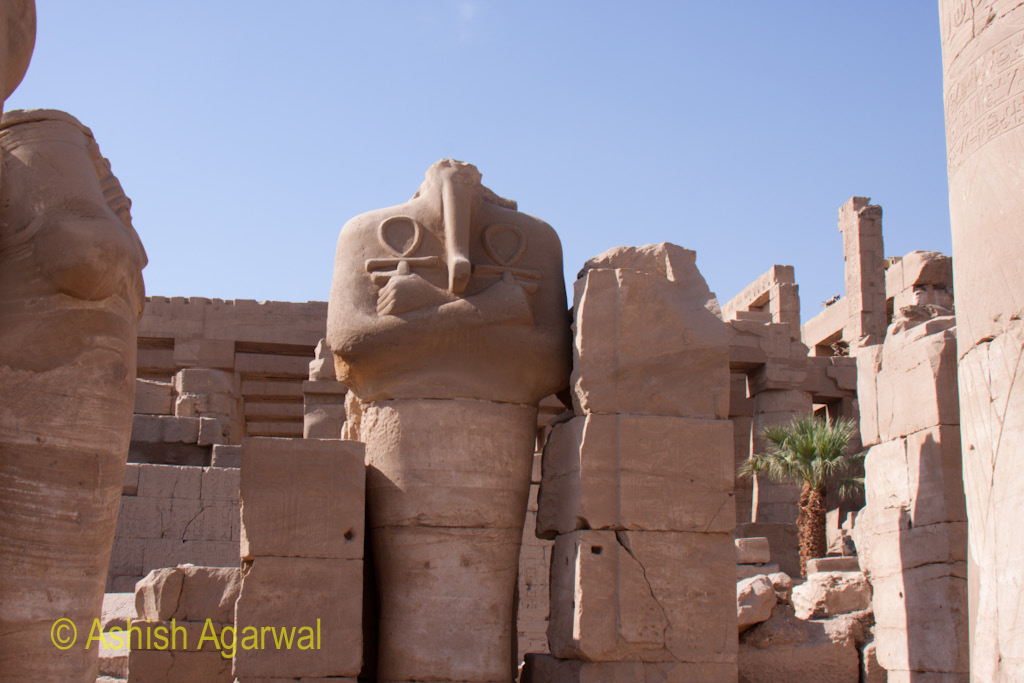
If you go to any of the ancient monuments in Egypt, you will find that there are numerous traces of the pharaoh who built them. This is typically true of the temples, where there will be statues of the pharaoh making up part of the structure of the temple, as a part of the walls of the temple or free standing statues.
Inside the Karnak temple, you can find more than one, since there were numerous pharaohs who played a role. In this case, you can see a statue which no longer has a head, but the rest of the statue remains in fairly good condition.
Learn more about places to visit in India. Buy Lonely Planet Guide to India.
Click to buy.
Want to improve your photos? Buy Photoshop and see how your images come to life.
Click to buy.
Want to get tips for improving your photography ?
Get Photo Tips from this blog.
The remains at the Karnak temple are pretty extensive. There has been a lot of restoration at the site, and some of the structures remain in pretty good condition, while the conditions of many of the other structures is far worse. This is a photo of a pillar at the temple, where the top parts of the pillar are no longer existing, and it seems that the pillar has been sliced into 1/3rd of the original section. This could be because the original pillar was made of several stone sections put on top of one another, and the sections on top got removed.
Learn more about Egypt. Buy the Lonely Planet Guide.
Click to buy.
Want to improve your photos? Buy Photoshop and see how your images come to life.
Click to buy.
Want to get tips for improving your photography ?
Get Photo Tips from this blog.
This photo was the first photo I took that actually showed the extent to which the structure inside the Karnak temple in Luxor has suffered over the centuries. The walls, pillars, and other structures all seem to have suffered different levels of damage, some of which seems more than that caused by weather (for example, the pillars seem to have suffered different levels of damage, with some sharp cuts, and other cuts where the cut is not smooth.
Learn more about Egypt. Buy the Lonely Planet Guide.
Click to buy.
Want to improve your photos? Buy Photoshop and see how your images come to life.
Click to buy.
Want to get tips for improving your photography ?
Get Photo Tips from this blog.
The obelisk is one of the most famous symbols of ancient Egypt, with the sharp and slim needle like structure having been taken to many cities of the world and erected in central locations. In this photo, you can see the top part of the Obelisk rising above the surrounding structures, which also is a contrast. The structures have all been weathered down, but the Obelisk still seems in pretty good condition, still seeming sharp and with the carvings on the Obelisk looking pretty good.
Learn more about Egypt. Buy the Lonely Planet Guide.
Click to buy.
Want to improve your photos? Buy Photoshop and see how your images come to life.
Click to buy.
Want to get tips for improving your photography ?
Get Photo Tips from this blog.
This photo actually shows the extent to which a lot of the structures inside the Karnak temple have suffered damage during the many centuries over which this temple has existed. The weather has been most cruel to the temples, with wear and tear, along with other phenomenon such as earthquakes also causing a lot of damage. It is only in the past few decades that there has been a focus on restoration, which has actually improved some aspects of the temple.
Learn more about Egypt. Buy the Lonely Planet Guide.
Click to buy.
Want to improve your photos? Buy Photoshop and see how your images come to life.
Click to buy.
Want to get tips for improving your photography ?
Get Photo Tips from this blog.
The Karnak temple is very old, atleast 35 centuries old. Given that it would have been exposed to so many disturbances over the past (both natural and man made), it can be hard to find anything remaining from that time.
Surprisingly, some of the parts of the temple still remain in good condition, but in this case, the place seems more in ruins, with damage visible everywhere.
Learn more about Egypt. Buy the Lonely Planet Guide.
Click to buy.
Want to improve your photos? Buy Photoshop and see how your images come to life.
Click to buy.
Want to get tips for improving your photography ?
Get Photo Tips from this blog.
The Karnak temple in Luxor is fairly busy with tourists through the year (although there is a reduction in tourists as you head towards the summer season because of the heat levels). In this photo, taken in February, you can see a number of tourists in the frame, walking in between the path with structures of the Karnak temples on both sides. It was impossible to take a photo of the structure without tourists being in the photo, just because of the number of tourists who were there in the temple complex.
Learn more about Egypt. Buy the Lonely Planet Guide.
Click to buy.
Want to improve your photos? Buy Photoshop and see how your images come to life.
Click to buy.
Want to get tips for improving your photography ?
Get Photo Tips from this blog.
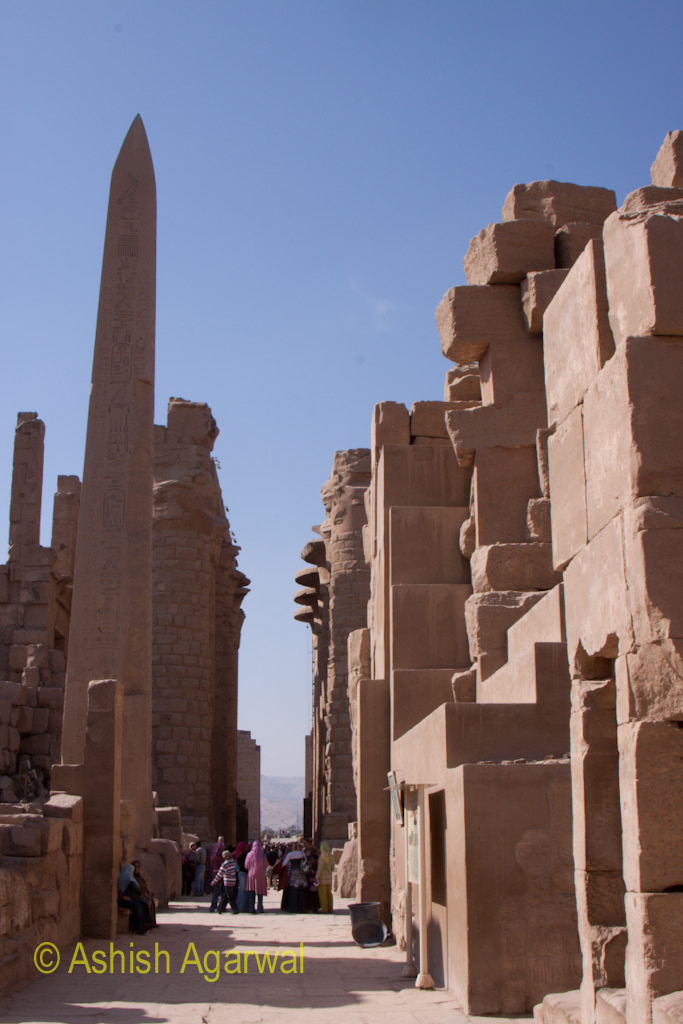
A number of tourists visit the Karnak temple at any point of time; since the Karnak temple is on the tourist circuit of Luxor and Luxor is an important point in anybody going to Egypt. This is true both for internal tourists (Egyptian citizens) and foreign tourists. In this photo, you can see several Egyptian tourists as well as the imposing and sharp profile of the Obelisk at one side of the structures.
Learn more about Egypt. Buy the Lonely Planet Guide.
Click to buy.
Want to improve your photos? Buy Photoshop and see how your images come to life.
Click to buy.
Want to get tips for improving your photography ?
Get Photo Tips from this blog.
Many of the sections of the Karnak temple are in some state of decay, which is not surprising given that the temple is around 35 centuries old, and hence would have some elements of wear and tear due to weather and other conditions over the years. The pillars inside the Hypostyle Hall are one of the most famous parts of the Karnak temple, and in this photo, you are able to see some of the pillars, with some damage over the years being visible.
Learn more about Egypt. Buy the Lonely Planet Guide.
Click to buy.
Want to improve your photos? Buy Photoshop and see how your images come to life.
Click to buy.
Want to get tips for improving your photography ?
Get Photo Tips from this blog.
The Sphinx is an integral part of ancient civilizations, especially an important of the ancient Egyptian culture. This photo shows a row of Sphinx statues at the entrance to the Karnak temple (and there is another such row on the other side as well). These are larger than life statues, and were in a fairly good condition, which was surprising, considering that they have been in place for around 35 centuries.
Learn more about Egypt. Buy the Lonely Planet Guide.
Click to buy.
Want to improve your photos? Buy Photoshop and see how your images come to life.
Click to buy.
Want to get tips for improving your photography ?
Get Photo Tips from this blog.
A smaller section inside the Karnak temple in Luxor; this is more of a run down section of the temple, with the stone seemingly having crumbled to some extent. Now of course, the whole temple would have been stabilized to ensure that there is no further decay or crumbling down of the stone. This looks like any other place, with nothing to highlight it in particular or to make it important for tourists.
Learn more about Egypt. Buy the Lonely Planet Guide.
Click to buy.
Want to improve your photos? Buy Photoshop and see how your images come to life.
Click to buy.
Want to get tips for improving your photography ?
Get Photo Tips from this blog.






 RSS
RSS
