 |
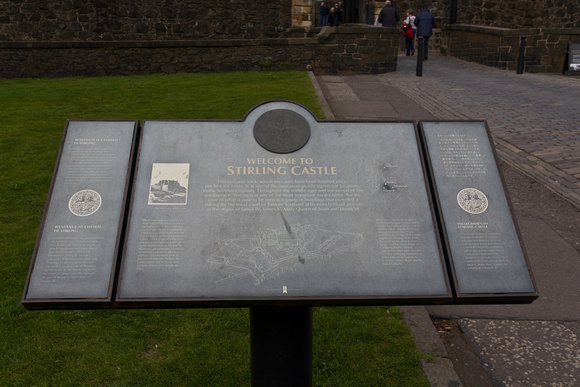
| The welcome plaque for the Stirling Castle at the entrance of the Castle (More photos here) |
The plaque near the entrance of the Stirling Castle. Stirling Castle is one of the most famous castles in Scotland, and along with the Edinburgh Castle, played a very strategic role in the medieval ages when there were constant skirmishes between the English and Scotsmen over their independence. In fact, one of the most famous battles during this fight happened nearby, where a contingent of Scots being led by 'Braveheart' William Wallace defeated an English army in the nearby battle of Stirling Bridge. The Castle is located on a height, a natural volcanic height, and has a commanding position over the entire surroundings.
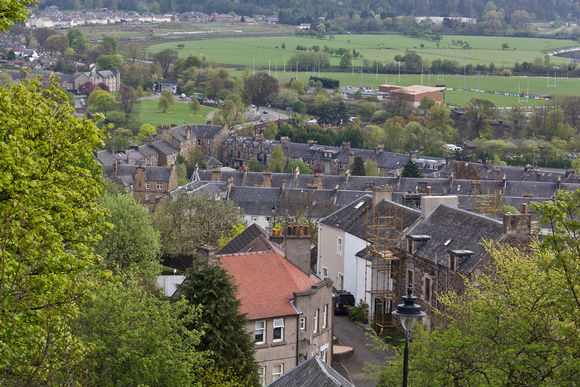
A view of the surrounding scenery and houses, showing the height at which the Castle is located. Of course, given that it is an important tourist attraction for anybody who comes to Stirling or even to Scotland, there is a very good road connectivity to the Castle. In the distance is rolling countryside, with farms and trees. It looks tremendously beautiful, especially on days when there is very clear visibility for long distances all around.
Print available for this image, in the form a
Digital Oil Painting at Fine Art America.
Robert Bruce was one of the leaders who was involved in the constant battle against the English rulers who were attempting to control Scotland. He was from one of the high families in Scotland, and had collaborated with the English at one point of time and fought with them at another point of time. Eventually, when the English were routed from there, he took over as the ruler of Scotland, and his statue is located near the entrance of Stirling Castle. The photo shows the high walls of the castle, and the yellow building in the rear is the refurbished and restored Great Hall inside the castle.
Want to improve your photos? Buy Photoshop and see how your images come to life.
Click to buy.
Want to get tips for improving your photography ?
Get Photo Tips from this blog.
The Stirling Castle in Scotland, located near the town of Stirling, is one of the most important marks of the Scottish medieval ages history, the time when there were constant skirmishes between the Scots and the English (which ended when they got a common king in 1603, and then they were merged around a hundred years later). Close by, one a bridge over the Stirling river, one of the important battles of this fight for retaining their independence was fought, celebrated in the movie "Braveheart".
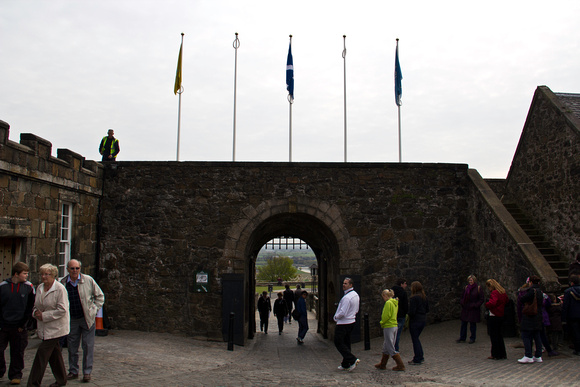
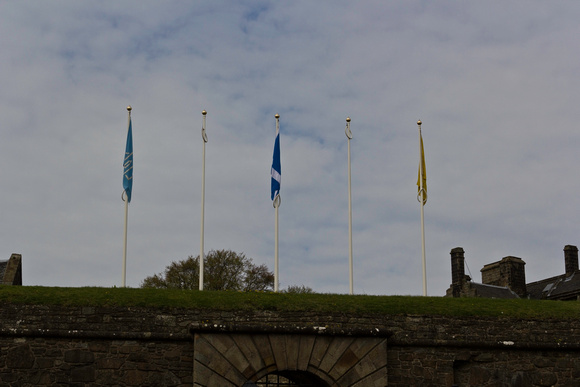
This is a photo near the entrance to the castle, and if you look through the entrance, you can see the gardens and even a hint of the river at lower levels (like most castles), the Stirling Castle is located at a higher level as a part of good defensive strategy. Over the entrance, you can see some flags, with the central flag being the Saltire, the Scottish Flag (as distinct from the Union Jack (the British Flag)). There are ongoing efforts to gain independence for Scotland, and the Saltire plays a key role in that.
If you want a print of this photo, available at
FAA.
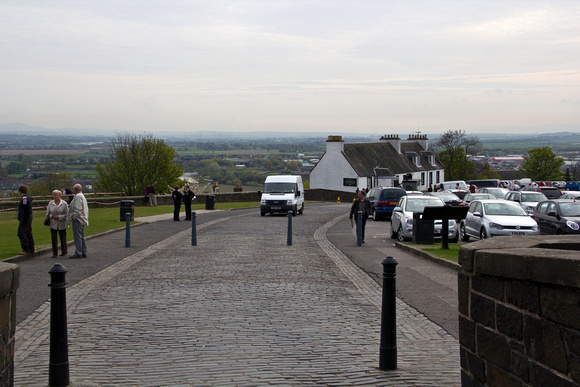
The Stirling Castle is located at a height over the surrounding, at a natural volcanic height called Castle Hill (the name sounds so appropriate, right?). The height and the natural beauty and greenery of the surroundings gives a beautiful look to the location, with houses and rolling meadows seen below. Vehicles are allowed upto the car parking which is located close to the entrance, but there will be some walking involved to the entrance, and of course, inside the castle, there will be more walking involved. The spot from where this photo was taken only allows vehicles belonging to the castle to go through, everybody else needs to park their vehicles in the car parking. From this location, there are also some view finders that allow you to see the landscape.
Prints of a version of this photo that has been converted into an Oil Painting
available at FAA.
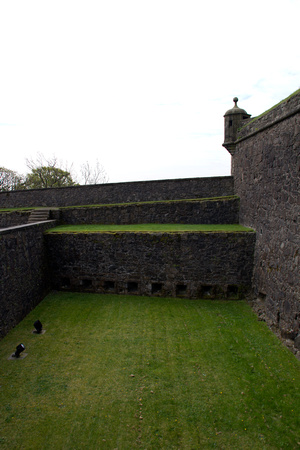
In addition to the huge advantage of being at a height from where you can see approaching enemies and try to pick them out as they climb up to reach the castle, there was the always the moat to deter attackers. This moat, now empty and looking beautifully green, would have been full of water and maybe some pollutants to deter people from trying to cross the moat other than through a narrow bridge (which could have been pulled up), all the while defenders from the top of the castle walls would have been attacking those who were attacking the castle. It looks so beautiful now, but is deep and would have been dangerous at those times.
Prints of a version of this photo that has been converted into an
Oil Painting available at 500px.
In the first photo above, visitors could be seen near and at the entrance to the Stirling Castle. This is a photo of the flags and flagpoles above the entrance. It was always interesting for me to see whether it would be the Union Jack (the official flag of Great Britain) or the Saltire (the Scottish Flag) at the various castles and other historical landmarks. In this case (and even at the Eilean Donan Castle), I could see the Saltire while the Union Jack was in a prominent position at Edinburgh Castle. I was hoping to get a photo with the flag fluttering, but there was no wind and hence no flutter.
Want to improve your photos? Buy Photoshop and see how your images come to life.
Click to buy.
Want to get tips for improving your photography ?
Get Photo Tips from this blog.
The Abu Simbel temple in south egypt is very famous. The temple was located at a lower level, and was threatened by the construction of the dam at Aswan, since the resultant Lake Nasser would have drowned the temple; as a result, along with European collaboration, the temple was disassembled from its earlier position and moved to a higher position (the current location), which is an engineering marvel, and the reason why the temple is so famous.
In this photo, you can see tourists standing next to a small structure, a short distance away from the actual temple.
blue photos
blue prints
Want to improve your photos? Buy Photoshop and see how your images come to life.
Click to buy.
Want to get tips for improving your photography ?
Get Photo Tips from this blog.
Some weather worn carvings on the walls of the Abu Simbel temple in south Egypt, located at a distance of 280 Km from the city of Aswan. The temple was built by the mega pharaoh Ramesses II as a reminder to his Nubian neighbors to the south about the immensity of his power, and also a reminder to his people about his being a living god.
This is a photo of some of the carvings on the walls of the temple, and shows a person in action, many many years ago.
blue framed prints
blue greeting cards
Want to improve your photos? Buy Photoshop and see how your images come to life.
Click to buy.
Want to get tips for improving your photography ?
Get Photo Tips from this blog.
The Karnak temple is around 35 centuries old, part of the Middle Kingdom in ancient egypt, and was built by a number of pharaohs (each pharaoh added his own touch (or in the case of Hatshepsut, the female pharaoh, she added the Obelisks inside the temple)). However, because of the age of the temple and neglect over the years, a lot of the temple is in some sort of worn down condition.
Want to improve your photos? Buy Photoshop and see how your images come to life.
Click to buy.
Want to get tips for improving your photography ?
Get Photo Tips from this blog.
You can just see a tourist entering the frame of the photo. This is a photo of the Karnak temple in Luxor, near the entrance. There is some restoration work ongoing in the temple, given that the temple has suffered hugely over the years from the wear and tear of the elements, along with neglect. It is only for the past several decades that there has been a lot more emphasis given on the restoration of the temple; important because of the huge heritage value and the number of tourists it draws.
Want to improve your photos? Buy Photoshop and see how your images come to life.
Click to buy.
Want to get tips for improving your photography ?
Get Photo Tips from this blog.
When you see most of the structures belonging to ancient Egypt, a large number of these structures are in some state of ruin, with the typical example being that the roof has fallen down in many of these. Even when you go to the Karnak temple, you can see the temple in various states of ruin; even in this photo of the Hypostyle Hall, you can see the roof has fallen down - there are just some architrave on top of the pillars inside the Hypostyle Hall.
Want to improve your photos? Buy Photoshop and see how your images come to life.
Click to buy.
Want to get tips for improving your photography ?
Get Photo Tips from this blog.
The Cachette Courtyard is the first court, with the courts being defined as the place between the pylons; the Cachette courtyard which was one of the first to be re-discovered. In addition, the Cachette courtyard was the location which was the start of the route taken by ceremonial processions to the Luxor temple. In addition, on the walls of the Cachette courtyard, the pharaoh Merenptah celebrated his victories over the Sea People.
Learn more about places to visit in India. Buy Lonely Planet Guide to India.
Click to buy.
Want to improve your photos? Buy Photoshop and see how your images come to life.
Click to buy.
Want to get tips for improving your photography ?
Get Photo Tips from this blog.
The Karnak temple in Luxor must be one of the rare such monuments which has 2 obelisks in the same complex (the ancient pharaohs used to place Obelisks at the entrance to temples, and the female pharaoh Hatshepsut created the obelisks, to be created in the city of Aswan).
In this photo, you can see the tops of both the Obelisks, rising above the structure of the Karnak temple.
Learn more about Egypt. Buy the Lonely Planet Guide.
Click to buy.
Want to improve your photos? Buy Photoshop and see how your images come to life.
Click to buy.
Want to get tips for improving your photography ?
Get Photo Tips from this blog.
The Karnak temple was built in many sections by a number of pharaohs, and is one of the largest temple complexes inside Egypt. When inside the temple, I felt the need for a guide the maximum, since there were many structures inside that did not make sense to me, and a guide could have explained some of these.
One of these is this cordoned off structure inside the Karnak temple. It could well be the base of something much larger, such as a huge statue, but I did not anything similar to this inside the temple.
Learn more about Egypt. Buy the Lonely Planet Guide.
Click to buy.
Want to improve your photos? Buy Photoshop and see how your images come to life.
Click to buy.
Want to get tips for improving your photography ?
Get Photo Tips from this blog.
In many of the previous photos, I have shown parts of the great Karnak temple in Luxor, as well as the crane that is there in the structure. In this photo, you can see how the actual size of the structure is pretty huge, and no photo (except for overhead photos) can really convey the true impression of the size of this temple. It seems remarkable that 35 centuries back, people could have constructed this huge temple, with so many artifacts inside it.
Learn more about Egypt. Buy the Lonely Planet Guide.
Click to buy.
Want to improve your photos? Buy Photoshop and see how your images come to life.
Click to buy.
Want to get tips for improving your photography ?
Get Photo Tips from this blog.
To get to the Khan el Khalili market in the Islamic Section of Cairo, you would normally take a bus or a taxi (or as part of a guided tour). You approach a square (with a small central garden), right next to the Al Azhar University, and get down there (and the entry point to the market is right next to the structures seen in this photo).
Your vehicle is not allowed to remain parked there, probably for security reasons, and you then make you way into the market, hopefully for some successful bargaining. Our travel in the market was remarkably safe, and we did not encounter any problem inside the market.
Learn more about Egypt. Buy the Lonely Planet Guide.
Click to buy.
Want to improve your photos? Buy Photoshop and see how your images come to life.
Click to buy.
Want to get tips for improving your photography ?
Get Photo Tips from this blog.
Obelisks are one of the most important symbols of ancient Egypt. The pharaoh would typically erect an Obelisk at the entrance to a temple, and you can find one at the entrance to the Karnak temple as well (although to a tourist, it no longer seems to be at the actual entrance to the temple).
In this photo, you can see the top portion of the Obelisk (with carvings being very clear visible) laid down on some supports inside the Karnak temple in Luxor. There must have been some restoration work happening over there.
Learn more about Egypt. Buy the Lonely Planet Guide.
Click to buy.
Want to improve your photos? Buy Photoshop and see how your images come to life.
Click to buy.
Want to get tips for improving your photography ?
Get Photo Tips from this blog.
The remains at the Karnak temple are pretty extensive. There has been a lot of restoration at the site, and some of the structures remain in pretty good condition, while the conditions of many of the other structures is far worse. This is a photo of a pillar at the temple, where the top parts of the pillar are no longer existing, and it seems that the pillar has been sliced into 1/3rd of the original section. This could be because the original pillar was made of several stone sections put on top of one another, and the sections on top got removed.
Learn more about Egypt. Buy the Lonely Planet Guide.
Click to buy.
Want to improve your photos? Buy Photoshop and see how your images come to life.
Click to buy.
Want to get tips for improving your photography ?
Get Photo Tips from this blog.
This photo was the first photo I took that actually showed the extent to which the structure inside the Karnak temple in Luxor has suffered over the centuries. The walls, pillars, and other structures all seem to have suffered different levels of damage, some of which seems more than that caused by weather (for example, the pillars seem to have suffered different levels of damage, with some sharp cuts, and other cuts where the cut is not smooth.
Learn more about Egypt. Buy the Lonely Planet Guide.
Click to buy.
Want to improve your photos? Buy Photoshop and see how your images come to life.
Click to buy.
Want to get tips for improving your photography ?
Get Photo Tips from this blog.
This photo actually shows the extent to which a lot of the structures inside the Karnak temple have suffered damage during the many centuries over which this temple has existed. The weather has been most cruel to the temples, with wear and tear, along with other phenomenon such as earthquakes also causing a lot of damage. It is only in the past few decades that there has been a focus on restoration, which has actually improved some aspects of the temple.
Learn more about Egypt. Buy the Lonely Planet Guide.
Click to buy.
Want to improve your photos? Buy Photoshop and see how your images come to life.
Click to buy.
Want to get tips for improving your photography ?
Get Photo Tips from this blog.
The Karnak temple is very old, atleast 35 centuries old. Given that it would have been exposed to so many disturbances over the past (both natural and man made), it can be hard to find anything remaining from that time.
Surprisingly, some of the parts of the temple still remain in good condition, but in this case, the place seems more in ruins, with damage visible everywhere.
Learn more about Egypt. Buy the Lonely Planet Guide.
Click to buy.
Want to improve your photos? Buy Photoshop and see how your images come to life.
Click to buy.
Want to get tips for improving your photography ?
Get Photo Tips from this blog.
Like some other previous photos, this photo also shows a section inside the Karnak temple in Luxor. The temple was a magnificent structure, constructed around 35 centuries past, with many pharaohs contributing towards the building of the temple (pharaohs would add their own touches to the existing temple). Now, you can see the remains of the temple, with a lot of the vertical structure still remaining, but most of the temple has lost a roof. Items such as this open doorway remain, and can be seen inside the temple in a number of areas.
Learn more about Egypt. Buy the Lonely Planet Guide.
Click to buy.
Want to improve your photos? Buy Photoshop and see how your images come to life.
Click to buy.
Want to get tips for improving your photography ?
Get Photo Tips from this blog.
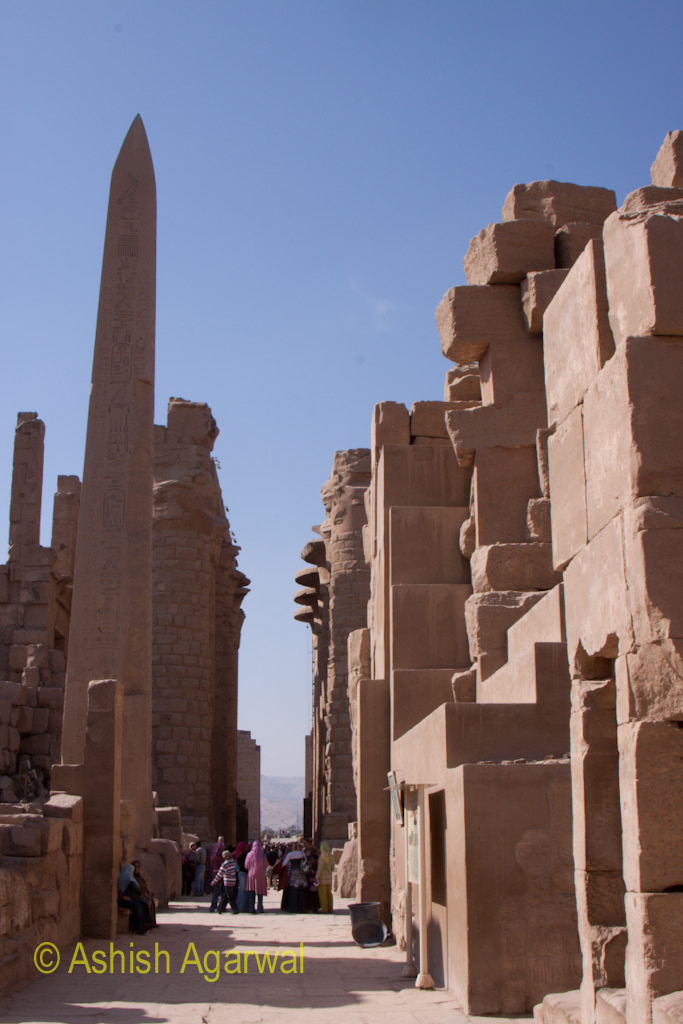
A number of tourists visit the Karnak temple at any point of time; since the Karnak temple is on the tourist circuit of Luxor and Luxor is an important point in anybody going to Egypt. This is true both for internal tourists (Egyptian citizens) and foreign tourists. In this photo, you can see several Egyptian tourists as well as the imposing and sharp profile of the Obelisk at one side of the structures.
Learn more about Egypt. Buy the Lonely Planet Guide.
Click to buy.
Want to improve your photos? Buy Photoshop and see how your images come to life.
Click to buy.
Want to get tips for improving your photography ?
Get Photo Tips from this blog.
A photo of a doorway inside the Karnak temple in Luxor. Most of the roofs of the temple are no longer present, so the whole structure looks a bit strange. The structure of a door is always strong in terms of architecture, so it was not surprising that the structure of the door would remain even when other areas get damaged over a period of time. I was also observing that most tourists were getting bored in such areas since there was nothing interesting to see.
Learn more about Egypt. Buy the Lonely Planet Guide.
Click to buy.
Want to improve your photos? Buy Photoshop and see how your images come to life.
Click to buy.
Want to get tips for improving your photography ?
Get Photo Tips from this blog.




 RSS
RSS


